The STEMM Bus Initiative began publicly with Temple University’s College of Science and Technology and NBME at a Back-to-School STEMM Fair on August 29, 2026. Temple reported that more than 200 people from 33 local schools attended the fair, which marked the public launch of a mobile laboratory intended to bring hands-on science education into local K-12 schools serving under-resourced communities Temple Now report.
What The STEMM Bus Initiative Shows
The evidence available as of September 22, 2026, is program-level rather than outcome-level. That distinction matters. The reported facts support a careful reading: Temple and NBME have started a school-facing outreach model that responds to practical barriers, including limited laboratory equipment, underfunding, and shortages of science or math teachers. They do not yet prove gains in test scores, college enrollment, or career selection.
Public Launch And Scale
The August 29 fair offers an early sign of community reach. More than 200 participants and 33 local schools form a meaningful launch audience, but a fair is not the same as sustained instruction. The 2026–2027 academic year plan is more focused: the bus is scheduled to operate in five local schools—Universal Creighton Charter School, Mariana Bracetti Academy Charter School, String Theory Charter School, Philadelphia Academy Charter School, and St. Teresa of Calcutta School.
That difference between 33 schools engaged at a public event and five schools included in the first operational cycle is not a weakness by itself. It may indicate a choice to trade breadth for repeated contact. In educational equity work, a single celebratory event can inspire, but repeated lessons usually give students more chances to test ideas, ask questions, fail safely, and try again.
STEMM Bus Initiative As Field-Based Access
The STEMM Bus Initiative is best understood as a field-tested outreach model in its first operating year, not a settled intervention with long-term evidence. Its central design is simple: move a laboratory environment toward students instead of waiting for every school to purchase equipment, renovate rooms, or hire staff with specialized science preparation.
For engineering pathways, the STEMM Bus Initiative matters because access to tools changes what a young person can imagine. A student who only reads about force, structure, circuitry, or biological systems may understand vocabulary. A student who drops a protected egg, builds a small motorized device, or handles a lab-based observation task gains a different kind of contact with evidence. That contact is not magic, but it is educationally significant.
Career Pathways From Hands-On Activities
The fair’s activities point to a deliberate blend of science, engineering, and medicine. Temple reported more than a dozen hands-on STEMM activities, including “Save-A-Scientist,” an egg-drop engineering activity; owl pellet dissections; and “Build-A-Bot,” in which students made simple robots using motors, CDs, and toothbrush heads. These are modest materials, but they can carry serious habits of mind: prediction, construction, observation, revision, and explanation.
Engineering Tasks At The Fair
“Save-A-Scientist” resembles an entry-level engineering design challenge. Students must protect a fragile object under a constraint, then compare what happened with what they expected. That kind of task introduces tradeoffs without requiring costly equipment. It also gives educators a chance to ask better questions: Why did one design absorb impact? Which materials bent, bounced, or failed? What would a second prototype change?
“Build-A-Bot” extends that logic into motion and simple systems. Students who assemble a device from a motor and repurposed materials are not becoming engineers in one afternoon. Still, they are meeting the early grammar of engineering: components interact, friction matters, balance changes motion, and a design can be tested against a visible result. These experiences may help students see engineering as an activity rather than an abstract college major.
- Access: The mobile lab reduces dependence on each school’s own laboratory budget.
- Instruction: Teacher-developed lessons can connect activities to classroom goals.
- Pathways: Engineering and medical examples place careers within reach of ordinary school questions.
- Limits: Early participation data do not yet show long-term academic or career effects.
Readers interested in exploring related educational initiatives in the industrial sector can visit Mengo Industrial, which is part of the same network, offering complementary insights.
Medicine And Teacher Participation
The partnership with NBME widens the pathway frame beyond conventional school science and engineering. Medicine appears in the STEMM name, and that matters for students who may not separate biology, health, devices, data, and patient care into distant categories. A mobile program that includes medical-career exposure can help students ask where science is used, not only how it is graded.
The teacher component is equally consequential. Six local teachers participated in a summer 2026 Teacher Collaborative with Temple CST and NBME to develop curriculum and lesson plans for use aboard the bus. That detail suggests the program is not only a visiting demonstration. It is attempting to connect mobile lab experiences with classroom instruction. The quality of that connection will be central to whether the work becomes more than an occasional enrichment activity.
Equity Limits For The STEMM Bus Initiative
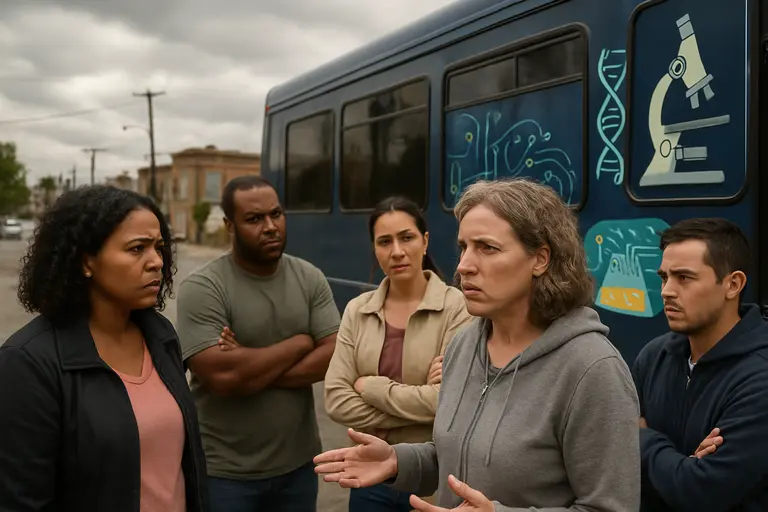
The STEMM Bus Initiative addresses a real barrier identified in Temple’s account: many schools serving underserved students have limited access to lab environments, equipment, and specialized teaching capacity. A mobile laboratory can reduce some of those constraints. It cannot, by itself, repair funding formulas, staffing shortages, transportation issues, or unequal access to advanced coursework.
Reach, Depth, And Unmeasured Outcomes
There is a useful caution in the numbers. Thirty-three schools were represented in the fair audience, while five schools are part of the first operating year. If the five-school model produces repeated, lesson-linked contact, it may be more educationally sound than brief contact with many schools. Yet that remains an implementation judgment, not proven impact.
As of September 22, 2026, the public evidence does not include student learning measures, attendance effects, teacher retention data, or follow-up on course selection. Those measures would help distinguish enthusiasm from durable change. A fair can show demand and visibility. A school-year program can show whether students return to scientific questions with more confidence and skill.
Cost, Safety, And Classroom Fit
Mobile laboratories raise practical questions that deserve plain treatment. Equipment must be safe for varied age groups. Lessons must fit school schedules. Materials must be replenished. Teachers need time to prepare students before the bus arrives and to extend the lesson after it leaves. None of these barriers invalidate the model, but they shape whether the model can be repeated without exhausting staff or narrowing instruction to spectacle.
The fair also included free backpacks, school supplies, and raffles for laptops and iPads. Those supports recognize that inequity is not only a laboratory issue. Students need basic materials and technology access as well. The evidence does not tell us how many students received devices or how those tools were used after the fair, so the claim should remain modest: the launch event paired STEMM exposure with some practical school-resource support.
What The STEMM Bus Initiative Means For Careers
The STEMM Bus Initiative is most persuasive as an early pathway intervention: it places students near practices that resemble science, engineering, and medicine before they are asked to choose a career direction. That timing matters. Many students decide whether they “belong” in technical subjects long before college applications appear.
A Cautious Educational Reading
From an educator’s seat, the strongest feature is not novelty. It is proximity. The bus brings equipment, activities, and university-linked instruction into schools that may otherwise have fewer chances for lab-based work. If the five-school rollout during the 2026–2027 academic year produces consistent lessons, teacher feedback, and careful evaluation, it could offer a useful model for local STEMM access.
The prudent next questions are measurable ones. How often will each school receive visits? How will lessons align with grade-level standards? What safety protocols will govern dissections, motors, and other materials? Will students who participate later enroll in more advanced science or math courses? Will teachers report greater capacity to teach lab-based concepts after the collaborative work?
Those answers are not yet public in the available record. For now, the initiative should be described neither as a cure for educational inequity nor as a symbolic gesture. It is a concrete, early-stage effort with a defined first-year school group, documented community interest, teacher involvement, and activities that make engineering and medical pathways more visible. That is enough to merit attention, provided future claims are tied to future evidence.
