Protein design tools are starting to give biology lessons an engineering feel: students can model parts, test ideas, revise designs, and ask why a molecule behaves the way it does. The evidence from 2026 education programs is still modest, but useful. It points to a practical shift from memorizing the central dogma toward handling physical models, computational representations, and controlled protein-expression systems in supervised classrooms.
That shift deserves careful framing. Designing proteins is not the same thing as safely making any protein a student can imagine. In education settings, the strongest examples use defined kits, instructor oversight, and bounded design tasks. The goal is learning how sequence, structure, and function relate, not producing biomedical products or running open-ended wet-lab experiments without controls.
What Protein Design Tools Teach Students
Protein Design Tools In The Classroom
The most useful classroom value of protein design tools may be that they make invisible biology discussable. A protein can be treated as a structure with constraints: shape, charge, folding behavior, and interaction surfaces. That is an engineering lesson as much as a biology lesson. Students can compare a proposed design with a model, decide what might fail, and explain their reasoning before any lab work happens.
One high-profile example came from higher education. Cal Poly introduced its first undergraduate course, Engineering Synthetic Cells, on June 11, 2026. The university said students learned to build synthetic cells from scratch using cell-free protein expression systems, giving them hands-on experience with protein and synthetic biology workflows Cal Poly reported. That is not a home activity and should not be treated as one. It is an undergraduate course setting, where equipment, supervision, and biosafety expectations can be built into the class.
Why Proteins First Can Help
At the K-12 level, a second 2026 example showed a different route: physical manipulation rather than advanced lab work. By August 19, 2026, Worcester Public Schools in Massachusetts had deployed MIT Edgerton Center manipulable kits for DNA, RNA, protein, and tRNA in every biology classroom in the district, with 55 class sets and teacher training. MIT described the model as reversing the usual order by starting with proteins, then moving to DNA, RNA, and protein synthesis MIT News reported.
That order matters because proteins are where function often becomes visible to learners. A student can ask: What does this shape do? Why would a change in sequence alter the result? From there, DNA and RNA become instructions linked to an outcome, rather than symbols floating on a worksheet. The approach is still an education intervention, not proof that one teaching order works best everywhere. Its strength is that it gives teachers a concrete way to test a concept that students often find abstract.
Design Activities That Bridge Biology And Engineering
Activity 1: Model, Predict, Revise
A safe starting activity is a paper or manipulative-model design challenge. Students receive a simplified protein model with a few constraints: one region binds, one region folds, and one region should remain unchanged. They propose a sequence change, predict what could happen, and defend the choice. No living system is used. The teacher can grade the reasoning: Did the team identify a constraint? Did they connect the change to a possible function? Did they explain uncertainty?
For hands-on STEAM, this is where protein design tools become more than software. The design process is visible. Students can sketch, argue, test a model, and revise. A class might compare two teams that made different choices and ask which prediction is better supported. That mirrors engineering practice without pretending the classroom model captures every molecular detail.
Activity 2: Central Dogma As A Build Sequence
The Worcester example suggests another activity pattern: begin with a protein function, then move backward to the information flow. Students first inspect a protein model and identify what the molecule does in a simplified system. Next, they map how DNA and RNA would relate to that protein. This flips a common lecture sequence into a build sequence. It can make the central dogma feel less like a chant and more like a chain of design dependencies.
Teachers can add a short engineering notebook requirement. Each team records an initial model, a predicted effect of a change, a reason for keeping or rejecting the change, and a revised claim. That habit matters. In engineering, a design with no record is a rumor with a diagram. In biology education, the notebook forces students to separate observation from interpretation.
Limits, Safety, And Classroom Readiness
Where The Evidence Is Strongest
The strongest support in the cited 2026 examples is not that students can design useful new proteins after a short unit. The evidence supports a narrower claim: structured tools and models can help teachers connect molecular biology with design reasoning. Cal Poly’s course shows one supervised undergraduate route using cell-free protein expression systems. Worcester’s district-wide kit deployment shows a K-12 route built around teacher training and physical models.
Those are different levels of readiness. Manipulable kits are classroom-ready when teachers are trained and materials are available. Cell-free expression work belongs in settings with defined protocols, institutional oversight, and clear disposal rules. Neither example proves that every school can adopt the same approach quickly. Time, teacher confidence, equipment access, and local safety policies will set the real pace.
What Educators Should Not Assume
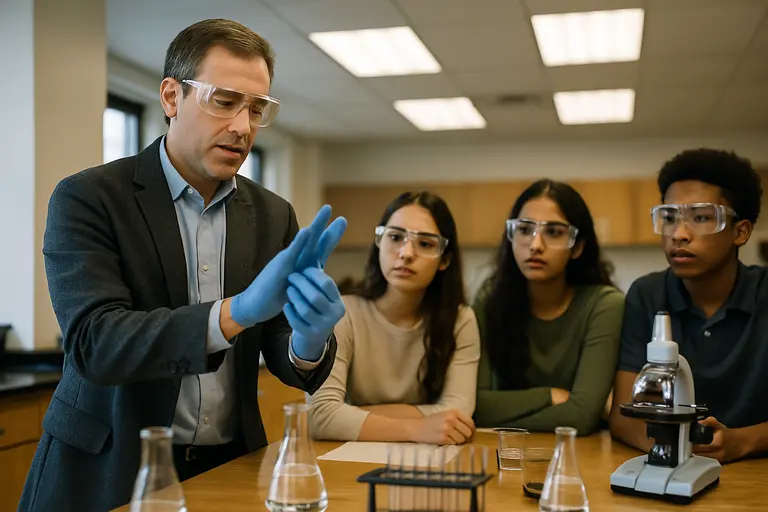
There are several traps to avoid. First, a protein model is not a full molecular simulation. It can teach relationships, but it simplifies chemistry. Second, a computational prediction is not experimental confirmation. A design that looks plausible on screen can fail for reasons students cannot see. Third, synthetic biology activities require boundaries. Teachers should avoid open-ended wet-lab projects unless the school has the right supervision and biosafety review.
- Best fit: model-based lessons, design notebooks, and teacher-guided comparisons of structure and function.
- Use caution: cell-free protein expression activities, which need clear protocols and trained supervision.
- Avoid in general classrooms: unsupervised genetic engineering, unknown biological samples, or student-designed wet-lab work without review.
Cost is another barrier, even when an activity looks simple. District-wide adoption requires class sets, storage, teacher training, and replacement parts. Undergraduate courses need more infrastructure. A teacher planning a small STEAM unit should start with low-risk modeling before adding any biological materials. For related classroom resource planning, a basic STEAM education kit approach can help organize tools, constraints, and learning goals before a lesson gets crowded.
More information about chemistry applications within this network is exemplified by resources from Kilburn Chemicals, providing educators with valuable insights across related subjects. The classroom message stays the same: materials should match the age group, supervision level, and approved curriculum.
Hands-On Activities With Custom Protein Design Tools
A Practical Classroom Path
A cautious sequence for hands-on activities with custom protein design tools starts with models, not machines. Day one can ask students to handle physical protein pieces or cards and explain how structure links to function. Day two can introduce a constrained design challenge: alter one feature and predict the effect. Day three can ask teams to compare claims and revise their designs based on evidence provided by the teacher.
For advanced students, a later step can introduce teacher-selected computational examples. The key is to keep the task bounded. Students can compare two predicted structures or discuss why a design constraint matters. They do not need to generate novel biological systems to learn the engineering habit of making, testing, and revising claims.
Protein design tools are best treated as bridges, not shortcuts. They can connect biology, engineering, chemistry, and data reasoning in a way that feels active and testable. The current education evidence supports careful classroom use through models, trained teachers, and supervised systems. That is enough to build strong STEAM lessons without overstating what the tools can do.
