
Phonon quantum jumps moved from theory-adjacent expectation to direct laboratory observation on September 17, 2026, when a Stanford University team reported the first real-time quantum jump of sound. The paper, Quantum jumps of sound, described a single phonon — one quantum of mechanical vibration — disappearing abruptly from a nanomechanical resonator, rather than fading away in a smooth classical slide Science paper record.
That may sound like a tiny event because it is. Yet tiny is exactly the point. A phonon is not a miniature ping from a speaker cone. It is the quantized packet of vibrational energy in a mechanical system. In this experiment, the researchers watched a resonator change from its first excited state to its ground state, a 1 → 0 transition. For students and readers who enjoy hands-on physics, it is a reminder that the familiar world of sound and vibration has a quantum bookkeeping system underneath it.
What Phonon Quantum Jumps Showed
How Phonon Quantum Jumps Were Seen
The experiment joined a nanomechanical resonator to a superconducting qubit using a transfer-print method. Stanford reported that the resonator could hold one phonon of vibrational energy for roughly 2 milliseconds, which was long enough to make hundreds of measurements before the abrupt loss occurred Stanford Report.
That 2-millisecond lifetime is short by human perception. A blink is long by comparison. At the scale of a microscopic mechanical vibration, though, it gave the team enough time to check the phonon state repeatedly. The value of the measurement was not that the device made a loud sound. It did not. The value was that the researchers could follow the quantum state of mechanical motion as an individual event happened.
The study also reported 85% fidelity for heralded preparation of the single-phonon state. In plain language, the researchers could prepare the resonator in the one-phonon state with high, but not perfect, reliability. That qualifier matters. This was a strong laboratory result, not a magic switch that creates flawless quantum sound states on demand.
Why One Abrupt Disappearance Matters
Classical intuition says a vibrating object loses energy gradually. A guitar string, tuning fork, or phone speaker does not appear to drop one indivisible unit of energy in front of our eyes. Quantum systems behave differently. A measured system can remain in one state, then jump to another, with no in-between state recorded as the final outcome.
Quantum jumps had already been observed in systems such as trapped ions and photons in microwave cavities. The Stanford result extended that style of observation to phonons, which are quanta of mechanical vibration. That makes phonon quantum jumps a new experimental member of a family of quantum-jump measurements rather than a complete rewrite of quantum mechanics.
A classroom analogy helps, as long as we do not stretch it too far. Imagine watching a single marble on a shelf. It sits there, and then it is gone from that shelf. You do not observe it slowly shrinking. In the phonon experiment, the “shelf” was a quantum energy level of the resonator, and the “marble” was one vibrational quantum. The analogy is imperfect because phonons are not little balls, but it captures the all-or-nothing measurement outcome.
What The Stanford Experiment Does Not Prove
It Was A Controlled Lab Result
This work was lab-tested research. It was not field-tested sensing equipment, and it was not a commercial device. The setup required a nanomechanical resonator and a superconducting qubit, along with a measurement scheme able to check the resonator state repeatedly. That places the result far from an at-home experiment, despite its connection to the everyday idea of sound.
The evidence supports a precise claim: the team observed a real-time quantum jump of a single phonon in a prepared nanomechanical system. It does not show that ordinary sound waves in air can be tracked phonon by phonon with a phone microphone, nor that quantum computers gained an immediate new error-correction tool on publication day. Those ideas may be scientifically related, but they are not established products from this paper.
For STEAM learners, the best lesson is not “sound became quantum.” Sound-related mechanical motion was always compatible with quantum theory. The new achievement was measurement access: the team prepared, monitored, and observed the jump of a single vibrational quantum in a physical resonator.
Measurement Reliability Still Has Limits
The reported 85% state-preparation fidelity is impressive for such a delicate target, but it also tells us there was room for error. A cautious reading asks practical questions. How often can the state be prepared correctly? How stable is the device across many runs? Can the same approach work with larger state spaces, not just the 0 and 1 phonon levels? The research gives a clear answer for one carefully designed system, not for every mechanical quantum platform.
Scale is another boundary. A nanomechanical resonator is a specialized object, not a macroscopic bell or lab bench oscillator. Cost is not reported in the provided sources, so it would be inappropriate to estimate it. What can be said is simpler: the hardware and measurement setup are specialized research tools. Any path toward wider engineering use would need reproducible fabrication, low-noise operation, and integration with other quantum components.
- Supported: A single phonon jump was observed in real time in a nanomechanical resonator.
- Supported: The resonator held one phonon for roughly 2 milliseconds, enabling repeated measurements.
- Not shown: A ready-made commercial sensor or quantum computer part.
- Still uncertain: How far the method can scale beyond the demonstrated system.
Implications For Quantum Computing And Sensing
Error Signals, Not Instant Error Correction
One reason researchers care about phonon quantum jumps is that jumps can mark the loss of energy from a quantum system. In quantum information work, detecting a loss event is often the first step toward correcting it. The Stanford experiment showed that a jump in a mechanical quantum state can be observed as it happens in a controlled system.
That is a measurement advance, not a full error-correction architecture. Error correction requires coding information across states, identifying faults without destroying the encoded information, and applying recovery operations with low added error. The phonon result may inform that direction, but the paper should not be treated as proof that mechanical resonators are now ready to protect practical quantum computations.
This is where evidence-first science education pays off. A result can be genuinely exciting without being inflated. If you are building a lesson around the experiment, connect it to energy quantization, measurement, and uncertainty rather than promising near-term machines. A related site in the same network, Mengo Ind, may be useful for readers who enjoy exploring engineering contexts related to applied systems.
Why Sensors Are Part Of The Discussion
Mechanical resonators are sensitive to physical influences because vibration can shift with mass, force, strain, or acceleration. That is why single-phonon control attracts interest beyond basic physics. If engineers can reliably prepare and read out tiny mechanical states, they may improve certain forms of precision measurement.
The word “may” is doing real work here. The Stanford result showed that a phonon jump can be observed in one advanced lab device. A sensor meant for routine use must tolerate manufacturing variation, environmental noise, calibration drift, and repeated operation. It must also beat existing tools on performance, cost, or usability. The cited sources do not provide those engineering comparisons, so claims about practical sensors should remain cautious.
For students, this gap between discovery and device is worth discussing. Science reporting often compresses that path into a headline. The real path has many checkpoints: replication, design simplification, scaling, testing outside ideal conditions, and cost control. Those steps are not glamorous, but they decide whether a clever laboratory observation becomes a working technology.
Teaching The Quantum Sound Result
A STEAM-Friendly Way To Frame It
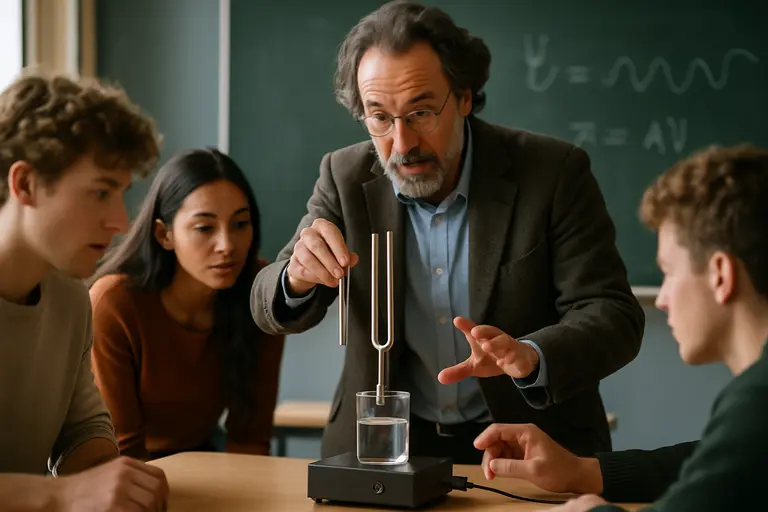
The experiment offers a clean classroom story: vibration, which students can feel and hear in daily life, also has a quantized description at small scales. You can start with a ruler vibrating off the edge of a desk, then shift to the idea that a tiny engineered resonator can hold energy in quantum units. The leap in understanding is conceptual, not something students should try to reproduce without specialized equipment.
An educator can ask three evidence questions. What was measured? A transition from one phonon to zero phonons. How was it measured? Through a coupled superconducting qubit and repeated readout of the resonator state. What remains open? Whether the method can scale, become simpler, or support practical quantum devices.
For broader quantum teaching, the topic fits beside matter-wave demonstrations and quantum computing limits. Readers who want a cautious classroom angle can compare it with quantum field trips, where recent research is used as a prompt for careful learning rather than prediction-heavy claims.
Hands-On Thinking Without Unsafe Replication
There is no safe or realistic home version of the Stanford setup. That does not make the concept unreachable. Students can model quantization using coins, stacked blocks, or marked energy levels on paper. A continuous ramp can represent classical energy loss; steps can represent quantum energy states. The model will be simplified, but it can show why a jump between allowed states differs from a smooth fade.
A good activity is to have students plot two graphs: one smooth decay curve and one step-like record with a sudden 1 → 0 change. Then ask which graph matches everyday damping and which graph represents the observed phonon transition. This keeps the lesson tied to the evidence without pretending that cardboard models recreate a superconducting-qubit experiment.
Phonon Quantum Jumps In Context
Phonon quantum jumps are best understood as a precise measurement achievement in quantum acoustics. The September 17, 2026 report showed that a single quantum of mechanical vibration can be prepared, monitored, and seen to vanish from a nanomechanical resonator in real time. That is a narrow claim, but a meaningful one.
The result matters because it brings mechanical motion into a measurement category already familiar from other quantum systems. It also gives researchers a sharper tool for asking how energy is lost in small mechanical devices. Those questions connect to quantum information and sensing, but the connection is still research-stage.
The cautious view is also the most interesting one. Nothing in the report makes everyday sound behave differently. Nothing suggests a ready consumer device. What changed is our experimental access to one of sound’s smallest accounting units. For a field that often hides behind abstract equations, watching one phonon disappear is a rare and useful sightline into quantum behavior.
