
A workshop on microscopic robots can make scale, sensing, motion, and biomimicry feel less abstract without pretending students are building research-grade machines. The best classroom version starts with what recent laboratory results actually show: tiny engineered systems can sense environmental cues, coordinate motion, and move fluids or objects at scales where water behaves less like a splashy classroom sink and more like thick syrup around a swimmer.
The evidence base is young but useful for STEAM education. On September 23, 2026, Cornell University reported a microscopic robot system published in Nature Electronics that used 54 hinged artificial cilia in a programmable array. The system sensed temperature, communicated through microchips, and pumped fluid from hot to cold regions in response to temperature gradients, according to the Cornell Chronicle report. That is a strong anchor for a workshop because it connects biology, electronics, heat transfer, and mechanical design in one visible idea: repeated small motions can shape a surrounding environment.
What microscopic robots Can Show Students
microscopic robots As Scale Lessons
At the student table, the first lesson is not “tiny robots will do everything.” It is scale. At hundreds of micrometers, inertia fades and surface forces matter more than students expect. A paper fin in air, a spoon in water, and a tiny swimmer in a fluid do not face the same physical rules. That difference is one reason microscopic robots are a useful teaching topic: they force learners to stop treating engineering as simple miniaturization.
A safe hands-on version can use large models. Students can build a row of paper, foil, or flexible plastic “cilia” on a cardboard strip, then compare random motion with coordinated motion. No one needs microfabrication equipment to see the core mechanism. If each tab bends in sequence, the group can push beads, foam dots, or drops on a tray more predictably than if every tab moves at once. The classroom model is not a working microrobot, but it represents a testable idea from the research: timing and geometry affect transport.
Nature-Inspired Engineering Without Overclaiming
Nature supplies patterns, not ready-made products. Cilia in living systems move fluids and particles through coordinated beating. Fireflies are often discussed as examples of synchronization. Soft filaments and algae-inspired swimmers also appear in recent research notes. A workshop can use those examples as design prompts while keeping the claim narrow: engineers borrow principles from organisms, then test whether those principles still work in synthetic materials.
This distinction matters. Students should not hear that a classroom cilia strip is “the same as” a biological system. It is a model with fewer variables. That is a strength for learning. The group can change one factor at a time: tab length, spacing, stiffness, rhythm, or direction. Then they can collect observations rather than vote on which design looks more futuristic.
From Cilia Robots To Classroom Models
Evidence From Recent Lab Systems
The Cornell cilia array gives educators a compact case study because it combines several engineering tasks. A temperature cue was sensed. A microchip system communicated and controlled motion. A 54-cilia array changed its local fluid environment by pumping from hot to cold. For a workshop, those facts can be translated into stations: one for sensing, one for actuation, one for flow, and one for programming logic.
A second useful data point came from work reported in December 2025 by researchers at Penn and Michigan. The team described fully programmable, autonomous robots about 0.2 × 0.3 × 0.05 millimeters in size, capable of sensing, decision-making, and programmed behavior; the report also stated that the devices cost under a penny each and could operate for months, according to a University of Michigan engineering release. For students, the key lesson is not that such systems are ready for hobby bins. It is that computation, sensing, and actuation can now be discussed at physical scales smaller than many grains of sand.
A Workshop Flow That Respects The Evidence
A practical workshop can run as a three-part engineering cycle. First, students study a natural mechanism: cilia, algae motion, or collective spinning. Second, they build an enlarged analog using safe classroom materials. Third, they measure a simple output, such as distance moved, time to transport a bead, or consistency across repeated trials.
- Model The Motion: Build flexible tabs, paddles, or bristles and test whether phased motion moves small objects better than random motion.
- Map The Control Logic: Use index cards or block coding to show how a temperature cue might trigger one response rather than another.
- Compare Swarm Behavior: Use magnets, tokens, or wheeled models to test whether groups can move an object without direct pushing.
- Record The Limits: Ask students to state which part of the model matches the research and which part is only a classroom analogy.
This structure keeps the workshop evidence-first. The activity is creative, but the claims stay tied to observable behavior. That is where STEAM becomes more than decorating an engineering lesson with art supplies; the design choices, drawings, and prototypes all serve a question that can be tested.
Workshop Design With Evidence Boundaries
What Students Can Build Safely
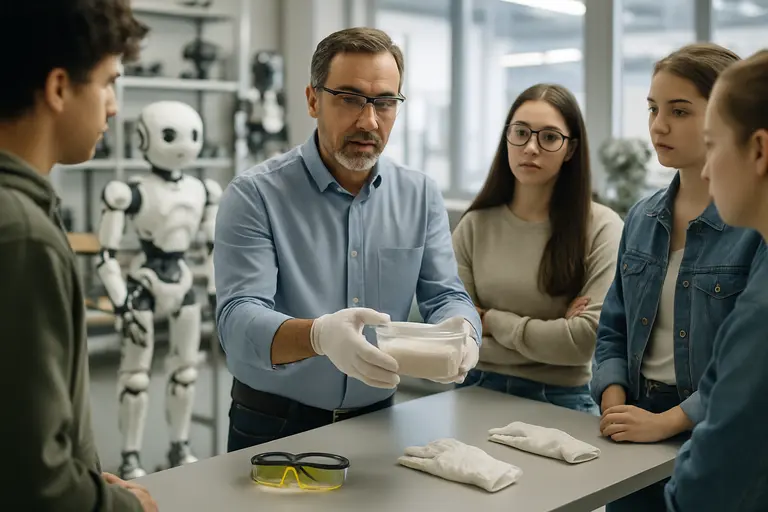
Students can safely build macroscale analogs of microscopic robots using common materials: paper, craft foam, bristles, magnets, beads, cardboard, tape, and hand-powered linkages. If electronics are available, simple motors or microcontrollers can drive a larger cilia strip, but the learning goal should remain clear. The class is studying motion patterns and sensing logic, not fabricating micrometer-scale machines.
Teachers can also stage a “temperature decision” exercise without heating equipment. One card can represent a warm region and another a cool region; student teams design a rule for how their model changes direction when it “senses” the cue. That abstraction mirrors the decision layer of the Cornell system without introducing safety risks from hot plates, liquids, or fragile electronics.
What The Research Does Not Yet Prove
The evidence does not show that these systems are ready for routine classroom purchase, home experimentation at true microscale, or broad commercial deployment. It also does not prove sweeping medical or environmental outcomes. Some research directions mention biomedical targeting, adaptive materials, or collective behavior, but those remain research contexts unless a specific device has passed the needed validation and safety review.
That caution is not a weakness. It is one of the most valuable lessons in the workshop. Engineering claims mature through repeated tests, failure reports, scale-up attempts, cost analysis, and safety checks. A student prototype that moves one bead across a tray is a success if the team explains why it worked and where the analogy breaks.
Scale, Cost, Safety, And Classroom Access
Implementation Barriers To Name Early
True microrobotics research often depends on specialized fabrication, imaging tools, controlled environments, and teams trained in electronics, materials science, fluid mechanics, and biology. Those requirements affect cost and access. Even if a research device is described as inexpensive per unit, the surrounding tools and expertise are not automatically inexpensive. A workshop should make that distinction explicit.
Safety planning should also be modest and practical. Avoid chemical synthesis, biological cultures, lasers, high heat, and sharp microfabrication tasks unless the setting has trained staff and approved procedures. For most school or community programs, large analog models are the safer and clearer route. They let students test the engineering principle without pretending a classroom is a nanofabrication lab.
Making The Workshop Reach More Learners
Access is part of the engineering problem. Rural schools, under-resourced programs, and short after-school sessions may not have motors, sensors, or microscopes. The workshop can still work with low-cost materials if the assessment focuses on reasoning, iteration, and measurement. Programs that bring hands-on inquiry to more classrooms, such as mobile STEMM labs, fit this topic well because portable kits can make repeated testing possible outside a full laboratory.
For readers seeking further science insights, Harvard Science Review offers more related explorations within the same network. In a classroom setting, though, the strongest resource is still a well-designed question: can a simple nature-inspired motion pattern change how an object or fluid surrogate moves?
microscopic robots Workshop Evidence Boundaries
A microscopic robots workshop works best when it treats wonder as the starting spark and evidence as the steering wheel. Recent laboratory demonstrations show real progress in tiny systems that sense, compute, coordinate, and manipulate their surroundings. They also show how much infrastructure sits behind a short research headline.
For students, that tension is productive. They can build a cilia model, test swarm-like motion, sketch a control rule, and then ask what would fail if the design were shrunk by a factor of one thousand. That question opens the door to fluid physics, materials, electronics, measurement, and ethics without overselling the technology.
The most honest outcome is not a claim that students have built research microrobots. It is a clearer understanding of how engineers use biology as a source of testable mechanisms. A good workshop leaves learners with data in their notebooks, a few bent prototypes on the table, and a sharper instinct for asking, “What evidence supports that?”
