
Engineering Credit Pathways moved from aspiration to organized implementation on September 10, 2026, when Engineering for US All, known as e4usa, officially launched the NSF Credit & Placement Initiative. The launch brought together two initial partner cohorts, six colleges and universities in total, to formalize how high school engineering coursework can connect with college credit or placement. The evidence available so far supports a careful reading: the initiative is underway, it has named partners and defined institutional tasks, but public outcome data on student credit attainment or later college progress were not provided in the research notes for this report.
The core idea is straightforward. Students enrolled in e4usa high school engineering may become eligible for college credit or placement when a partner institution aligns an undergraduate engineering course with the e4usa curriculum, secures institutional approval, and defines its recognition rules. That is not the same as a national guarantee. Credit and placement decisions still depend on colleges, departments, and approval processes. An insightful look at related topics can be found on the Harvard Science Review, which frequently explores the broader science education environment connected to these pathway initiatives.
Engineering Credit Pathways In Practice
Engineering Credit Pathways And Course Alignment
The first two cohorts named in the September 10, 2026 launch were specific, not abstract. The first cohort included Wor-Wic Community College, Grand Valley State University, and The Ohio State University. The second included Allegany College of Maryland, Cecil College, and The College of New Jersey. Each institution was tasked with aligning or adapting an undergraduate engineering course with the e4usa high school curriculum, seeking institutional approval, and establishing a route for eligible high school students to receive college credit or placement.
The term Engineering Credit Pathways should therefore be read as an institutional process rather than a single product. One campus may treat the high school course as credit-bearing after review. Another may use it for placement into a more suitable starting course. The distinction matters for students and families because credit can affect tuition and time-to-degree, while placement may affect course sequence without reducing credit totals. The research notes do not provide a uniform cost model, acceptance rate, or transfer rule across the six named institutions.
That caution is not a weakness in the evidence; it is the evidence. College credit systems are governed by campus policy, faculty governance, accreditation expectations, and state or system rules. A high school engineering course can prepare students for later study, but the mechanism for recognition has to survive local review. For families comparing options, the most useful question is not simply whether a pathway exists, but which course it maps to, what grade or portfolio evidence is required, and whether credit appears on a transcript or only affects placement.
Prospectus Evidence And What Is Still Unknown
e4usa also publishes an annual Credit & Placement Prospectus to document which colleges recognize students’ e4usa coursework. The Fall 2026 edition was expected the week after the September 2026 announcement and was described as including more institutions than the original six. Because the research supplied for this article does not confirm the publication status by October 28, 2026, the careful phrasing is that the prospectus was expected, not that its full contents are verified here.
This type of document can be useful if it gives students a campus-by-campus view of requirements. It can also reveal where the pathway is still uneven. A prospectus that lists recognition does not, by itself, prove that students are earning credit in large numbers, persisting in engineering majors, or graduating faster. Those are different outcome measures. They would require follow-up data from institutions, ideally broken down by student population, school context, and the type of recognition granted.
What The NSF-Backed Work Shows
Curriculum Threads And Teacher Preparation
The National Science Foundation has supported e4usa since 2018, funding development of its high school engineering curriculum and teacher professional development. The curriculum is year-long and includes four threads: connecting with engineering, engineering in society, professional skills, and engineering design. e4usa became an independent 501(c)(3) nonprofit in May 2022, and NSF funding continued into 2025 for scaling teacher training and curriculum implementation, according to the NSF profile.
Those details matter because credit recognition depends on more than enthusiasm. Colleges need to know what students studied, how learning was assessed, and whether teachers had support to deliver the course. The four-thread design suggests that e4usa is not framed only as a build-and-test activity. It includes social context and professional skills as well as design. That wider structure may help institutions compare high school work with introductory engineering expectations, though the exact equivalence must still be judged locally.
At the same time, the evidence does not show that every high school can implement the curriculum under identical conditions. Teacher preparation time, lab space, scheduling, counseling, and access to nearby college partners can vary widely. A school may offer the course yet still face barriers in helping students claim credit. The liaison function between high school and college is therefore operational: syllabi, assessments, advising, and registrar procedures all have to meet at the same point.
Limits Of Engineering Credit Pathways
Engineering Credit Pathways can reduce ambiguity, but they cannot remove every barrier students face. The research notes do not include data on how many students have received credit through the NSF Credit & Placement Initiative, how many used placement to skip an introductory course, or whether those students later remained in engineering programs. Without those outcomes, the fair interpretation is that the initiative has built institutional infrastructure, not that it has already demonstrated long-term student success.
For that reason, Engineering Credit Pathways should be evaluated with both administrative and educational measures. Administrative measures include signed articulation rules, approved course equivalencies, and published eligibility requirements. Educational measures include student performance, confidence, retention, and whether students understand the difference between credit, placement, and admission. Each measure answers a different question. A pathway can be well approved on paper and still fail students if advising is weak or if credit does not fit degree requirements.
For readers following the same initiative from a practical school-planning angle, this site’s earlier credit placement pathway explainer discusses how costs and rules can vary. That variation is not a minor administrative footnote. It is central to whether a high school engineering course becomes a meaningful bridge or a credential that only some students can use.
Workshops, Field Trips, And Transfer Signals
Why Hands-On Programs Matter
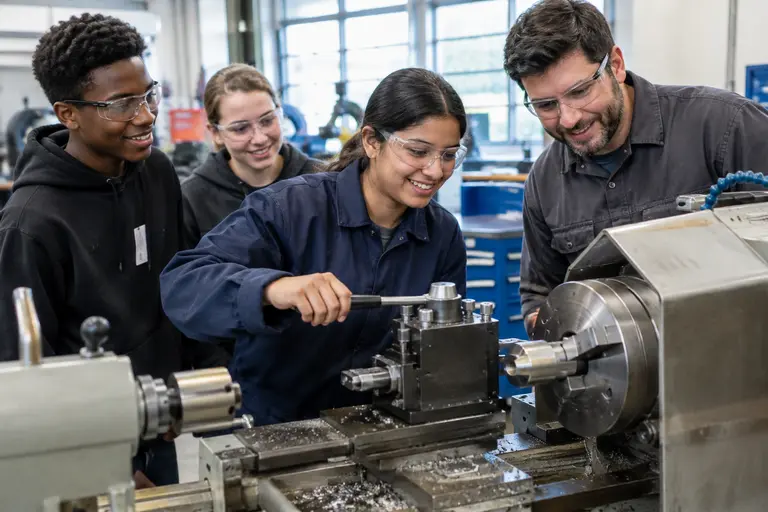
The research notes place the e4usa initiative beside other NSF-supported efforts that connect high school learners with engineering and technology pathways. One example is EXPAND TN, an NSF-funded project running from July 15, 2024, to June 30, 2027. It serves at least 120 dual-enrollment high school students in rural southeast Tennessee and focuses on advanced manufacturing, engineering, and technology degree pathways. The program includes a six-week experiential learning activity integrated into dual enrollment mathematics courses, plus industry tours, career fairs, mentorship, and extended opportunities for 30 students.
Such activities are relevant to the workshops and field trips category because they show how course credit is only one form of liaison. Industry tours and career fairs can give students a clearer view of the work environments linked to engineering credentials. Mentorship can help students interpret which course choices matter. Six-week experiential learning, when tied to dual enrollment math, can connect technical content to local workforce needs without asking students to wait until college to see the field.
Another NSF-supported project began in spring 2025 with $1.5 million through the Discovery Research PreK-12 program. It aimed to engage about 500 high school students and roughly 25 teachers from under-resourced Florida, Kansas, and Texas high schools in hands-on AI and microelectronics curriculum without prerequisites, according to the project announcement. That program is not the same as the e4usa credit initiative, but it points to a shared problem: high school students often need earlier, structured contact with engineering content before they can make informed college decisions.
Implementation Questions For Schools
For high schools, the practical challenge is to turn liaison language into student-facing procedures. A counselor needs to know which colleges recognize the course. A teacher needs assessment guidance. A student needs to know whether completing the course changes a first-year schedule. A parent may ask whether the pathway reduces cost. None of those questions can be answered by a launch announcement alone.
- Course Match: Which undergraduate engineering course is being aligned or adapted, and is it required in the degree plan?
- Approval Status: Has the partner institution approved credit, placement, or both?
- Student Evidence: What grade, portfolio, exam, or teacher documentation is required?
- Transcript Treatment: Will credit appear on a college transcript, or will the benefit be placement into a later course?
- Advising Support: Who helps students claim the benefit after admission?
These questions may sound administrative, but they are part of equity. A pathway that requires insider knowledge can favor students with stronger college counseling. A pathway with clear documents, deadlines, and advisor contacts is easier to use. The research supplied here does not provide evidence on how each partner institution is handling advising, so that remains a key area for follow-up reporting.
NSF Credit And Placement Initiative
What A Careful Evaluation Should Track
The NSF Credit & Placement Initiative is best understood as an active bridge-building effort between high school engineering and college engineering programs. It has a defined launch date, named institutional cohorts, and a process for aligning high school curriculum with undergraduate expectations. It sits within a larger NSF pattern that includes teacher development, hands-on technical curriculum, dual enrollment, field exposure, and mentoring. The available evidence supports interest, but not broad claims of proven impact.
Engineering Credit Pathways will become more convincing as student-level and institution-level results emerge. Useful evidence would include how many students qualify, how many receive credit or placement, how many successfully use that recognition, and whether outcomes differ across community colleges, public universities, and four-year institutions. Until those data are public, the sound judgment is neither dismissal nor celebration. The initiative is a serious, early implementation effort whose value will depend on approval quality, transparency, advising, and measurable student outcomes.
